Research on the Engineering Talent Shortage Says We Should Start Worrying
The engineering and manufacturing talent shortage isn’t just a buzzword. Its impact is both global and local. Read on to dig into the shortage.


Did you check out our recent 2019 Hiring Insights in Engineering yet? We’ve got the research to prepare for your 2019 hiring initiatives. Go check it out, then meet us back here.
The talent shortage.
A long-time buzzword in the engineering and manufacturing sectors – one you’d be tempted to tune out by now. Except it hits too close to home to ignore; your productivity, growth, customer service, and innovation are just a handful of areas that vacancies will negatively impact – and the talent shortage ensures that those vacancies will take at least three months to fill, according to surveyed manufacturers.
By 2028, a continued shortage will translate to a potential loss of $454 billion in economic output – a massive 17% of the forecasted manufacturing GDP in the US.
For many companies, it’s tempting to throw money at the problem and forget about it – offer higher salary packages to attract the right talent or invest in automation technology to relieve the demand for transactional labor. But it’s not enough.
Take a look at this graphic from Deloitte and The Manufacturing Institute. Can money really fill the gap of 2.4 million manufacturing vacancies by 2028?
The engineering and manufacturing talent shortage isn’t just a buzzword. Its impact is both global and local. The need to tackle this challenge is not dependent upon revenue size, organizational demographics, or reach. It’s a commitment needed by every company.
We dig into more detail below. Grab a cup of coffee and read on.
The engineering and manufacturing industries are contending with historically-low unemployment rates in combination with the industry’s significant contribution to economic expansion. The result is the tightest labor market in recent history. But the root causes of this talent shortage go deeper.
Shrinking Immigration
The STEM workforce in the US has long been home to a significant portion of talented foreign-born workers – about 20-25% according to the American Immigration Council. However, the number of international students has declined a massive 17% in recent years – primarily due to changes in visa regulation. Furthermore, while large organizations in the manufacturing/engineering fields have historically been the biggest sponsors of H-1B visas for foreign workers, that number has similarly decreased.
Companies are left to turn to domestic talent, which is a far smaller pool of professionals.
Aging Workforce
A SHRM report suggests that almost 27% of workers in the manufacturing sector will retire within the next decade. Baby Boomers – and even some older members of Generation X – are out the door, taking their knowledge and skills with them. Not only are many companies lacking sufficient succession planning and knowledge transfer strategies, but there simply isn’t enough talent to fill the gap.
Decline in STEM Interest
Last year, the number of teenage boys interested in a STEM career dropped from 36% to 24% while the number of teenage girls is stagnant at just 11%. Only 3 in 10 parents consider advising their child to go into manufacturing. Some claim that an unfavorable perception of the industry is the root cause of this disinterest.
Consider the automotive industry, one expert points out; the emotional response tied to the Big Three automotive brands is nowhere near as exciting as that tied with Tesla, known for its innovation. But Tesla is not what people initially think of when considering a career in manufacturing. In fact, less than half of surveyed Americans believe that manufacturing jobs are “interesting, rewarding, clean, safe, stable, and secure.” With such a dismal view of the industry, it’s little wonder why enrollment in these fields is stagnant or, worse, declining.
Lack of Women in Engineering and Manufacturing
As mentioned, only 11% of teenage girls are interested in STEM careers. The number of female engineering graduates is higher – at 24% – but that’s still drastically uneven, despite the fact that women outnumber men in overall graduate school enrollment. Studies show that the US manufacturing workforce consists of just 29% of women workers. This lack of women in engineering and manufacturing is certainly perpetuating the talent shortage.
Unfortunately, there’s no one-size-fits-all approach to address the talent shortage in the engineering and manufacturing fields.
The right solution depends upon a number of factors, including regional differences in skills demand and current STEM offerings, to name a couple. That said, we’ve seen companies find success in some of the following solutions.
Investing in STEM Development
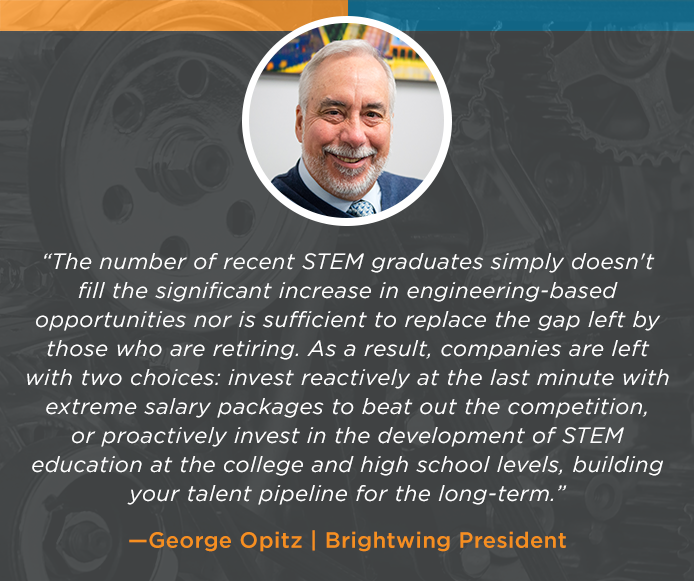 Getting involved at the college and high-school levels to promote STEM careers is one of the most proactive approaches to solving the talent shortage. Not only are you able to build your long-term talent pipeline, you’re also building employer brand awareness, which is highly valuable in attracting greater numbers of candidates.
For example, global manufacturer Cummins, Inc. created its own initiative to address the skills gap, called the Technical Education for Communities program (TEC). It’s a program that works with schools to identify and supplement gaps, helping them standardize teacher training, market-relevant curriculum, classroom tools and systems, and career guidance. It’s an extensive investment, but one that pays off by improving overall STEM education and sparking greater career interest.
Hand-in-hand with STEM education investment is the opportunity to get more girls interested in careers in fields like engineering and manufacturing. A Microsoft general manager Shelley McKinley points to studies that show girls need more role models: “Where are the women STEM teachers? Girls are more interested in hands-on experience; they want to see the life applications of what they are learning.” Companies can take a proactive approach in getting the right role models in front of this young audience to boost their interest in STEM.
Creative Compensation Packages
Many organizations hear the phrase talent shortage and act in a reactive manner, throwing money at the problem to gain the talent they need. Higher wages and sign-on bonuses are common strategies – and Deloitte reports a 68% positive impact from companies who go this route. It seems like a viable solution – for now.
But it’s a short-term fix. It doesn’t guarantee that the people lured in by the money will stay for the long haul or that the future talent pool will miraculously grow as a result. Plus, it’s expensive. The average US engineer wage sits at $91,010, reaching even higher depending on experience level and regional bias. How long will this strategy remain valuable?
Flexible Skills Requirements
Sometimes, the talent pool only seems limited because a company’s long list of requirements is so stringent.
Finding the perfect candidate in the current market is going to prove highly difficult. However, a more flexible approach to requirements will result in a wider range of available candidates. We’ve seen the success of this strategy first-hand. An automotive client spent six months trying to find a highly technical engineer with extensive experience in a long list of very specific skills. We helped them pare that list down and expanded the search from local to national (introducing a relocation package), resulting in a wider array of highly qualified people who fit the job.
Training Junior Professionals
Not only will getting more flexible on requirements help, but intentionally hiring more junior people can also open up the talent pool.
This strategy goes hand-in-hand with valuable training programs as well as knowledge transfer initiatives – especially as your oldest generation of workers gets ready for retirement. To aid in this effort, some manufacturers have already implemented short-term project opportunities for retiring individuals, allowing them to work in a smaller capacity in order to increase (or maintain) headcount while enabling greater knowledge transfer to junior employees.
Implementing Automation
Automation does not solve the engineering and manufacturing talent shortage, but it does help address the challenge in the meantime.
The World Economic Forum suggests that by 2022 42% of total task hours will be managed by machines and algorithms. As such, one in three manufacturers are already using these tools and technologies to supplement low-skilled jobs in order to focus their recruiting efforts on higher-skilled roles. As a result, 64% of executives have found that automation helps them overcome the challenges of the talent shortage.
* * *
At the end of the day, it’s clear that leaders in the engineering and manufacturing fields cannot remain silent about the talent shortage. Industry growth and demand are opening up more and more employment opportunities – and the only way to fill those positions is to be proactive about filling your talent pipeline.
 https://gobrightwing.com/wp-content/uploads/2025/04/welcome-handshake-teamwork-and-ceo-in-business-me-2023-11-27-05-32-52-utc.jpg
548
800
dkourani@gobrightwing.com
https://gobrightwing.com/wp-content/uploads/2026/04/logo-300x94.webp
dkourani@gobrightwing.com2025-07-14 14:43:312026-01-19 11:13:30Contract vs. Permanent Employment: Which Is Right for Your Business?
https://gobrightwing.com/wp-content/uploads/2025/04/welcome-handshake-teamwork-and-ceo-in-business-me-2023-11-27-05-32-52-utc.jpg
548
800
dkourani@gobrightwing.com
https://gobrightwing.com/wp-content/uploads/2026/04/logo-300x94.webp
dkourani@gobrightwing.com2025-07-14 14:43:312026-01-19 11:13:30Contract vs. Permanent Employment: Which Is Right for Your Business? https://gobrightwing.com/wp-content/uploads/2025/06/The-Role-of-Employer-Branding-in-Attracting-Top-Talent.jpg
1250
2000
dkourani@gobrightwing.com
https://gobrightwing.com/wp-content/uploads/2026/04/logo-300x94.webp
dkourani@gobrightwing.com2025-06-23 15:21:312026-01-19 11:13:30The Role of Employer Branding in Attracting Top Talent
https://gobrightwing.com/wp-content/uploads/2025/06/The-Role-of-Employer-Branding-in-Attracting-Top-Talent.jpg
1250
2000
dkourani@gobrightwing.com
https://gobrightwing.com/wp-content/uploads/2026/04/logo-300x94.webp
dkourani@gobrightwing.com2025-06-23 15:21:312026-01-19 11:13:30The Role of Employer Branding in Attracting Top Talent https://gobrightwing.com/wp-content/uploads/2025/04/When-is-the-Right-Time-to-Hire-Employees.png
600
1200
dkourani@gobrightwing.com
https://gobrightwing.com/wp-content/uploads/2026/04/logo-300x94.webp
dkourani@gobrightwing.com2024-10-05 01:36:472026-01-19 11:13:31When is the Right Time to Hire Employees? 5 Workforce Planning Tips
https://gobrightwing.com/wp-content/uploads/2025/04/When-is-the-Right-Time-to-Hire-Employees.png
600
1200
dkourani@gobrightwing.com
https://gobrightwing.com/wp-content/uploads/2026/04/logo-300x94.webp
dkourani@gobrightwing.com2024-10-05 01:36:472026-01-19 11:13:31When is the Right Time to Hire Employees? 5 Workforce Planning Tips https://gobrightwing.com/wp-content/uploads/2025/04/What-is-a-Technical-Recruiter.png
600
1200
dkourani@gobrightwing.com
https://gobrightwing.com/wp-content/uploads/2026/04/logo-300x94.webp
dkourani@gobrightwing.com2024-10-05 01:27:412026-01-19 11:13:31What is a Technical Recruiter & How Do You Hire One in 2024?
https://gobrightwing.com/wp-content/uploads/2025/04/What-is-a-Technical-Recruiter.png
600
1200
dkourani@gobrightwing.com
https://gobrightwing.com/wp-content/uploads/2026/04/logo-300x94.webp
dkourani@gobrightwing.com2024-10-05 01:27:412026-01-19 11:13:31What is a Technical Recruiter & How Do You Hire One in 2024? https://gobrightwing.com/wp-content/uploads/2025/04/Blog-Banner-Ziad-Mike-1.jpg
1200
1920
dkourani@gobrightwing.com
https://gobrightwing.com/wp-content/uploads/2026/04/logo-300x94.webp
dkourani@gobrightwing.com2024-09-13 14:00:372026-01-19 11:13:31From Referral to Reality: Finding My Passion
https://gobrightwing.com/wp-content/uploads/2025/04/Blog-Banner-Ziad-Mike-1.jpg
1200
1920
dkourani@gobrightwing.com
https://gobrightwing.com/wp-content/uploads/2026/04/logo-300x94.webp
dkourani@gobrightwing.com2024-09-13 14:00:372026-01-19 11:13:31From Referral to Reality: Finding My Passion https://gobrightwing.com/wp-content/uploads/2025/04/Professional-Hiring-Agency.png
600
1200
dkourani@gobrightwing.com
https://gobrightwing.com/wp-content/uploads/2026/04/logo-300x94.webp
dkourani@gobrightwing.com2024-09-10 19:34:072026-01-19 11:13:32You Don’t Need Another Professional Hiring Agency. You Need This Instead.
https://gobrightwing.com/wp-content/uploads/2025/04/Professional-Hiring-Agency.png
600
1200
dkourani@gobrightwing.com
https://gobrightwing.com/wp-content/uploads/2026/04/logo-300x94.webp
dkourani@gobrightwing.com2024-09-10 19:34:072026-01-19 11:13:32You Don’t Need Another Professional Hiring Agency. You Need This Instead. https://gobrightwing.com/wp-content/uploads/2025/04/Employment-Staffing-Agency.png
600
1200
dkourani@gobrightwing.com
https://gobrightwing.com/wp-content/uploads/2026/04/logo-300x94.webp
dkourani@gobrightwing.com2024-09-10 18:28:402026-01-19 11:13:32How to Hire the Wrong Employment Staffing Agency
https://gobrightwing.com/wp-content/uploads/2025/04/Employment-Staffing-Agency.png
600
1200
dkourani@gobrightwing.com
https://gobrightwing.com/wp-content/uploads/2026/04/logo-300x94.webp
dkourani@gobrightwing.com2024-09-10 18:28:402026-01-19 11:13:32How to Hire the Wrong Employment Staffing Agency https://gobrightwing.com/wp-content/uploads/2025/04/5.4-Blog-Banner-4.png
1280
2560
dkourani@gobrightwing.com
https://gobrightwing.com/wp-content/uploads/2026/04/logo-300x94.webp
dkourani@gobrightwing.com2024-05-15 13:00:562026-01-19 11:13:32Hiring a Marketing Manager that Meets Your Team’s Needs
https://gobrightwing.com/wp-content/uploads/2025/04/5.4-Blog-Banner-4.png
1280
2560
dkourani@gobrightwing.com
https://gobrightwing.com/wp-content/uploads/2026/04/logo-300x94.webp
dkourani@gobrightwing.com2024-05-15 13:00:562026-01-19 11:13:32Hiring a Marketing Manager that Meets Your Team’s Needs https://gobrightwing.com/wp-content/uploads/2025/04/5.14-Blog-Banner-3.png
1280
2560
dkourani@gobrightwing.com
https://gobrightwing.com/wp-content/uploads/2026/04/logo-300x94.webp
dkourani@gobrightwing.com2024-05-15 13:00:492026-01-19 11:13:33Managing the Hiring Process Through a Staffing Agency in Detroit
https://gobrightwing.com/wp-content/uploads/2025/04/5.14-Blog-Banner-3.png
1280
2560
dkourani@gobrightwing.com
https://gobrightwing.com/wp-content/uploads/2026/04/logo-300x94.webp
dkourani@gobrightwing.com2024-05-15 13:00:492026-01-19 11:13:33Managing the Hiring Process Through a Staffing Agency in Detroit